Misunderstanding AI in general

Disclaimer
This is a personal opinion and should not be taken as professional advice. The views expressed here are not targeting any specific individual or organization, rather it is a general commentary on the state of AI understanding in corporate environments. Names mentioned are purely for illustrative purposes and do not imply any endorsement or criticism.
The Lack of Understanding AI
We all feel it: that uncomfortable moment when corporate leaders talk about AI with enormous confidence, while their decisions suggest that the technology is not always deeply understood. AI appears in earnings calls, product roadmaps, internal initiatives, and corporate strategy decks, sometimes because it genuinely solves a problem and sometimes because organizations are afraid of appearing to fall behind.
I don't find that particularly surprising. Companies respond to competitive pressure, investor expectations, cost reduction, and customer demand. But those incentives can encourage adoption faster than understanding.
I was writing this post to capture my thoughts on corporate AI and the general lack of understanding surrounding it; However, I realized my thoughts are a bit broader and encompass the overall societal implications and challenges posed by AI technology.
What Sparked This Realization
AI is not inherently a replacement for people. It is a tool capable of augmenting human ability, automating portions of work, and—in some cases—replacing work that people previously performed.
I mean, this is one of the most norm-shattering technologies of our time. It's hard to pinpoint exactly if AI is beneficial or not because it impacts almost every single aspect of our lives, from healthcare to finance, from education to entertainment. The political landscape, regulatory frameworks, and societal norms are all being challenged and reshaped by the rapid advancement of AI technologies.
What would AI have to do for you to consider it a net positive? What would make it a net negative?
On the plus side, it has given society some of the most amazing tools for achieving efficiency, productivity, ambition, and innovation. Even for me, I'm exploring skills and fields that were previously a mystery or out of reach, thanks to the capabilities that AI provides. It's shaped my career in many ways.
On the downside, and this is an important consideration, AI is a disruptor and an uncertainty-generating technology. It has and will continue to displace jobs. It also raises ethical concerns, privacy issues, and the potential for biased decision-making.
One of the changes I find most interesting isn't job displacement at all. It's cognitive displacement. Every time I ask an AI system to structure an argument, remember syntax, summarize something complicated, or finish a sentence, I'm choosing not to perform some portion of that cognitive work myself.
That isn't necessarily bad. Calculators did the same thing for arithmetic, search engines for recall, and GPS for navigation. But technologies don't simply give us new abilities; they also change which existing abilities we regularly exercise. AI may do this at a scale we've never experienced before because language and reasoning touch almost everything we do.
I will admit, autocomplete and recommendation systems are so tempting to use. I actually use this blog now to document my own personal experiences, thoughts, and reflections on AI. It's hard to not use autocomplete to make these blogs, but I'm focusing on maintaining authenticity.
What a crazy world we live in, eh?
AI is powerful enough to change how we THINK. How we WORK. How we live our LIVES.
And yet we're still remarkably uncertain about where all of this leads.
Algorithms on our social feeds are constantly showing us what the leaders of AI are promising.
Look, a new model! Whoa! Opus 5.5 rivals Fable! Oh, Astra has sick 3D modelling capabilities!
Leaders want us excited like this. Corporate teams are often under pressure to adopt these technologies to keep pace with competitors, meet rising customer expectations, improve productivity, and reduce costs. AI realists are having to explain to regular people the limitations, risks, and realistic capabilities of these technologies.
AI Realist vs 20 Pro-AI - Surrounded*
Here's a video that illustrates the dynamic between an AI realist and multiple pro-AI advocates:
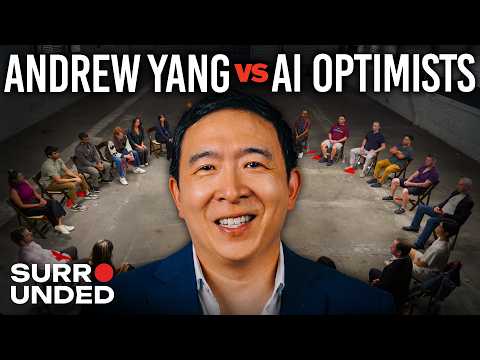
* I am not affiliated with Surrounded or any of the individuals featured in the video.
Remember Andrew Yang's warnings about automation during the 2020 U.S. presidential campaign? At the time, much of the discussion around large-scale technological displacement felt theoretical. In retrospect, the underlying question of "what happens when automation advances faster than labour markets adapt?" feels considerably less abstract.
Yang Gang.
It's a cycle driven more by perception than by genuine understanding or strategic foresight. Why are we doing this? What's so beneficial about short-term gains when the long-term implications are so profound? Are we following the hype without thinking enough about who controls these technologies, whose incentives shape their development, and who ultimately benefits from their deployment?
Why I Think About This Differently
During my academic years, I spent a significant amount of time studying artificial intelligence and machine learning. I built neural networks, worked through concepts such as backpropagation and model training, and learned how systems adjust parameters based on data and error signals. AI's fundamental principles are not new; they have really been around for decades.
What changed wasn't the existence of these ideas, but the scale: vastly more compute, data, investment, engineering talent, and infrastructure made it possible to push decades-old concepts much further than before. Maybe my perspective is partly shaped by having studied the technology closely. Knowledge can create optimism, but it can also make certain risks harder to ignore.
It's similar to the saying, "ignorance is bliss."
I don't think optimism and concern are opposites here. You can believe AI will produce extraordinary benefits while also believing that the pace of development deserves scrutiny. In fact, the more powerful you believe the technology can become, the more seriously you should probably take its risks.
I really admire Dario Amodei's letter to slow down the pace of AI development. It's a reminder that there are leaders who truly are concerned that we are not being safe enough in our approach.
Okay, so what should we understand about AI?
Great Denis, you have experience in AI development, you're concerned about its impact, and you're trying to make sense of it all. What about it? What do I gain from reading your thoughts on this?
It is not magic
This is not a silly little tool that you can dismiss. AI has the potential to become one of those foundational technologies (like electricity, computing, or the internet) that reshapes entire industries rather than merely creating a new category of software. This technology is built on decades-old research in computer science, mathematics, and cognitive science. Behind every polished response sits an enormous ecosystem of research, training data, computing infrastructure, human feedback, engineering, evaluation, and experimentation.
Do Not Fall Behind
If you ignore the advancements in AI, you risk falling behind in both personal and professional contexts. The technology is evolving rapidly, and those who fail to understand and adapt to it may find themselves at a disadvantage. Staying informed and developing a basic literacy in AI concepts can help you make better decisions, leverage new tools effectively, and remain competitive in an increasingly AI-driven world.
You are still in control
AI may seem like a tool that will replace human decision-making entirely. I think perception is the first step. I think of this similarly to how farmers first adopted mechanized farming equipment; initially, there was skepticism and fear, but over time, they learned to integrate these tools into their workflow, enhancing productivity without losing control over the farming process. Mechanized farming didn't eliminate the need for farmers; it changed what farming required of them. New skills became valuable, some forms of labour became less important, and productivity increased dramatically. AI may produce a similar shift across knowledge work—not necessarily removing people from every process, but changing which parts of the process require human effort.
Closing Thoughts
Maybe the goal isn't to decide whether AI is “good” or “bad.” Electricity isn't good or bad. The internet isn't good or bad. These technologies amplify what people are capable of doing, while creating consequences that societies spend decades learning to manage.
I suspect AI will be similar.
So I'm trying not to worship it, fear it, or dismiss it. I'm trying to understand it.
And I think more of us should.