Meadow: Leave a Song Somewhere Real

You cannot listen to a song in Meadow from your sofa. You have to get up and walk to it.
That is the whole product. Somebody stood in a real place, left a track there, and it stays at those coordinates until it fades. To hear it, you have to go where they were.
Think of the way people used to carve initials into a tree, except the thing left behind is music.
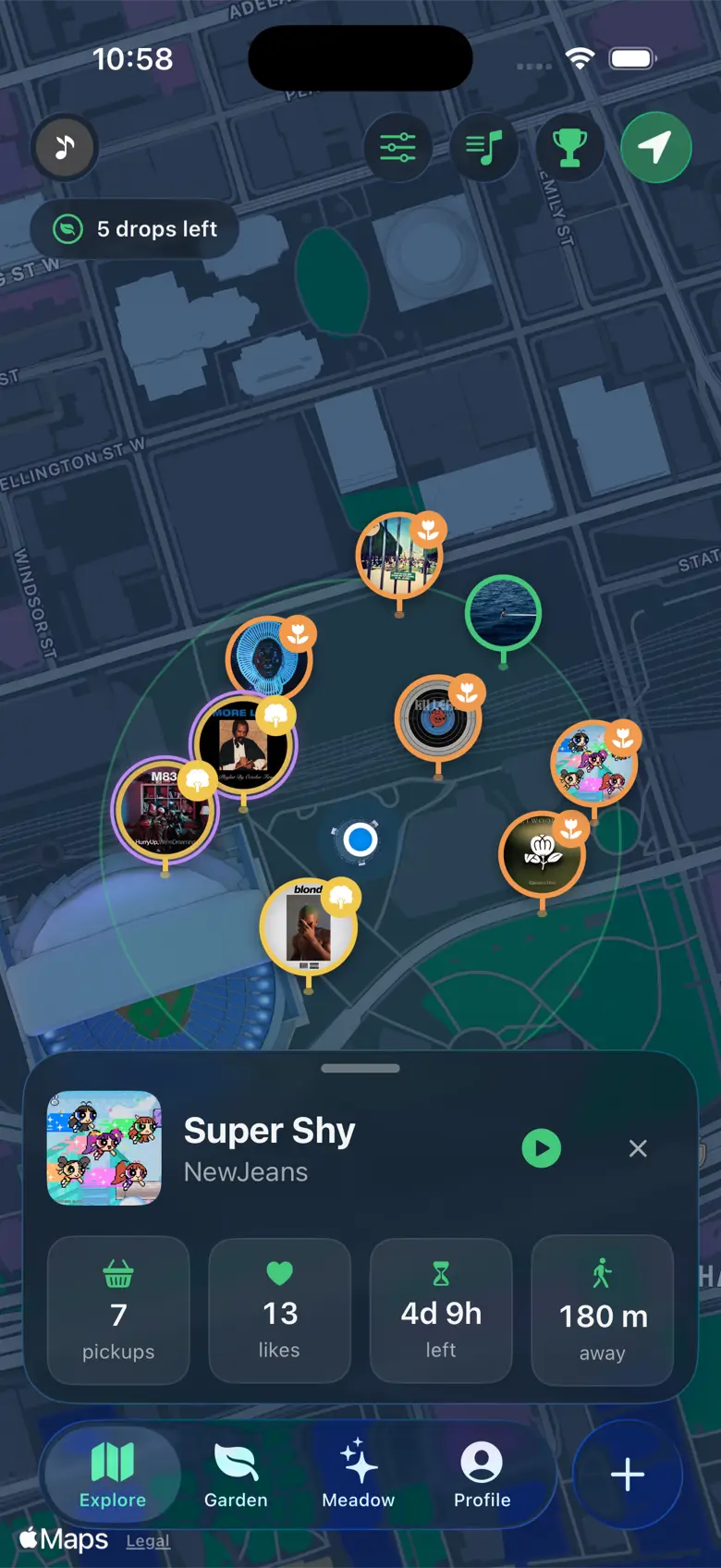
Songs appear on the map only once you are close enough. The card shows how many people have picked this one up, and how far you still have to walk.
The one rule that shapes everything
You cannot get at a song without going where it is.
Every decision in the app gets checked against that sentence. It sounds like a limitation. It is actually the only reason the app is interesting.
Two distances make it real:
- You can see a song when you are within 200 metres of it.
- You can take it when you are within 25 metres.
Outside those distances, it does not exist for you. There is no world map to browse, no list of what is hot in another city, no way to collect anything from bed.
Take that away and Meadow becomes a worse Spotify. Keep it, and a walk to the shop becomes something you might do a slightly different way.
Leaving a song
You search for a track, drop it where you are standing, and add a note if you want to say something.
That note is where the app gets personal. A song on its own is a recommendation. A song plus "I can't believe I got to hear this live" pinned to the venue where it happened is a small piece of someone's memory, left for a stranger.
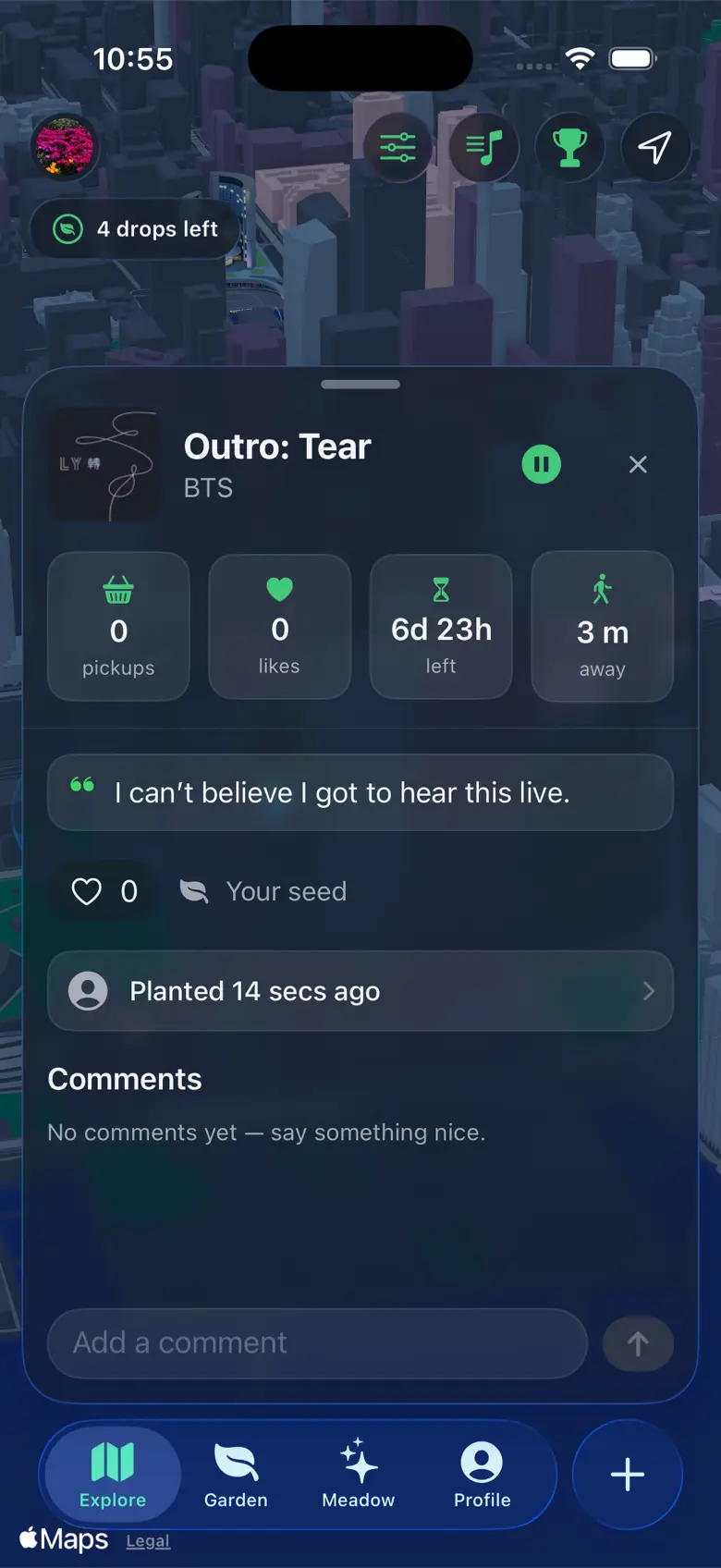
Each song carries a note, a comment thread, and a countdown. This one has six days left before it disappears.
Songs do not last forever. On a free account, a song you plant lives for seven days and then it is gone.
I went back and forth on that, and kept it because permanence would ruin the thing. A city where every song ever planted still sits there is a city of clutter. Expiry means the map reflects who is out walking now, not who was enthusiastic in 2026.
Songs grow when people find them
A song you leave does not sit still. It changes based on how many people have picked it up.
| Stage | Pickups |
|---|---|
| Sprout | 0 to 2 |
| Bloom | 3 to 9 |
| Tree | 10 or more |
The marker on the map grows with it. If you plant something in a busy square and it turns into a tree, you can see that happen without anyone telling you.
It is a small thing that does a lot of work. It rewards choosing a good spot, and it makes a well-placed song feel like it belongs to the place rather than to you.
Your garden keeps everything
Anything you collect goes into your garden, and it stays there permanently. The song you picked up expires on the map for everybody else. Your copy does not.
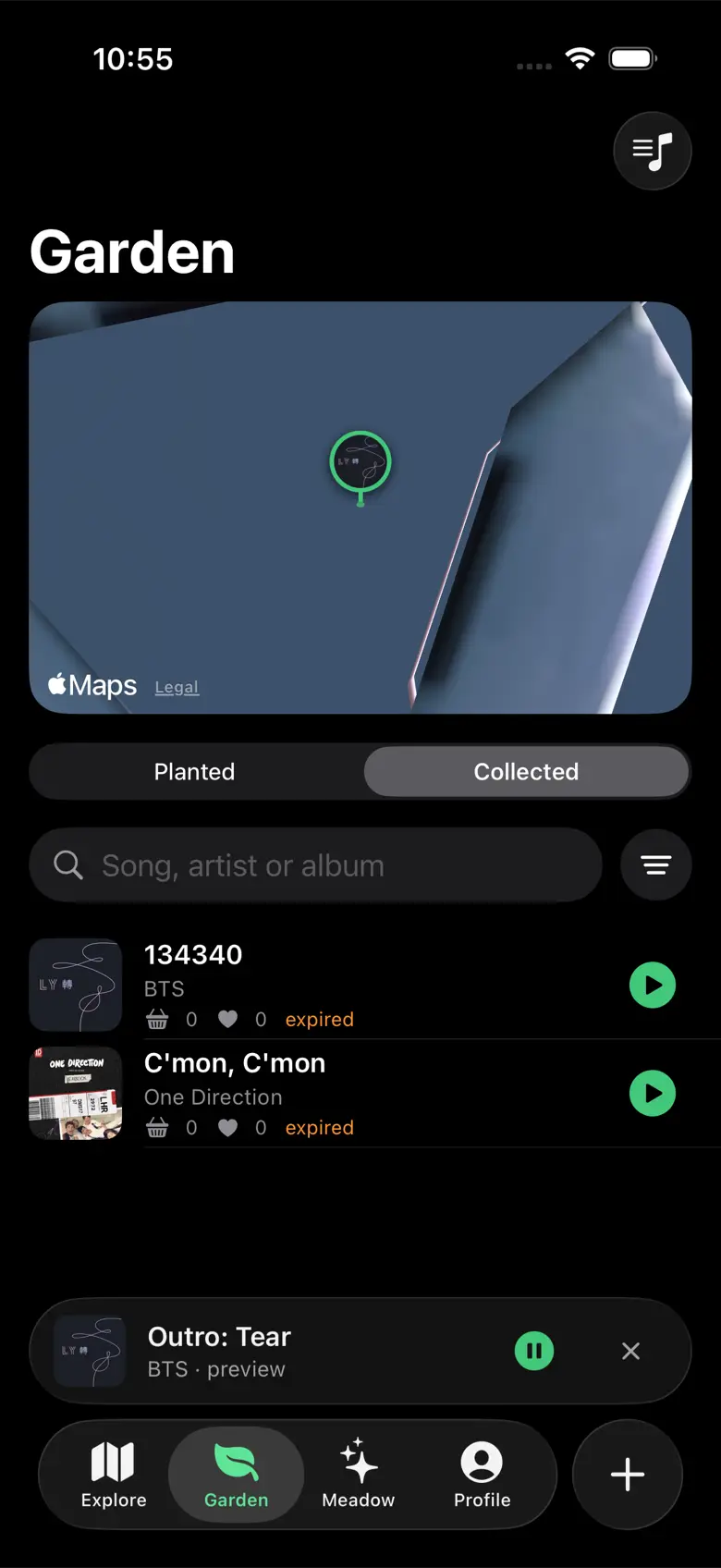
Collected songs stay in your garden even after they have expired out in the world.
Over time this becomes a strange and quite personal record. Not a playlist you assembled, but a list of places you actually went, in the order you went to them.
If you subscribe to Apple Music, you can push the whole garden out as a playlist.
A feed that refuses to give directions
There is a social side: posts, replies, likes, reposts, and a feed of what people are planting.
It has one deliberate hole in it. The feed never shows coordinates. It tells you somebody planted a song in "Downtown Toronto" and nothing more precise than that.
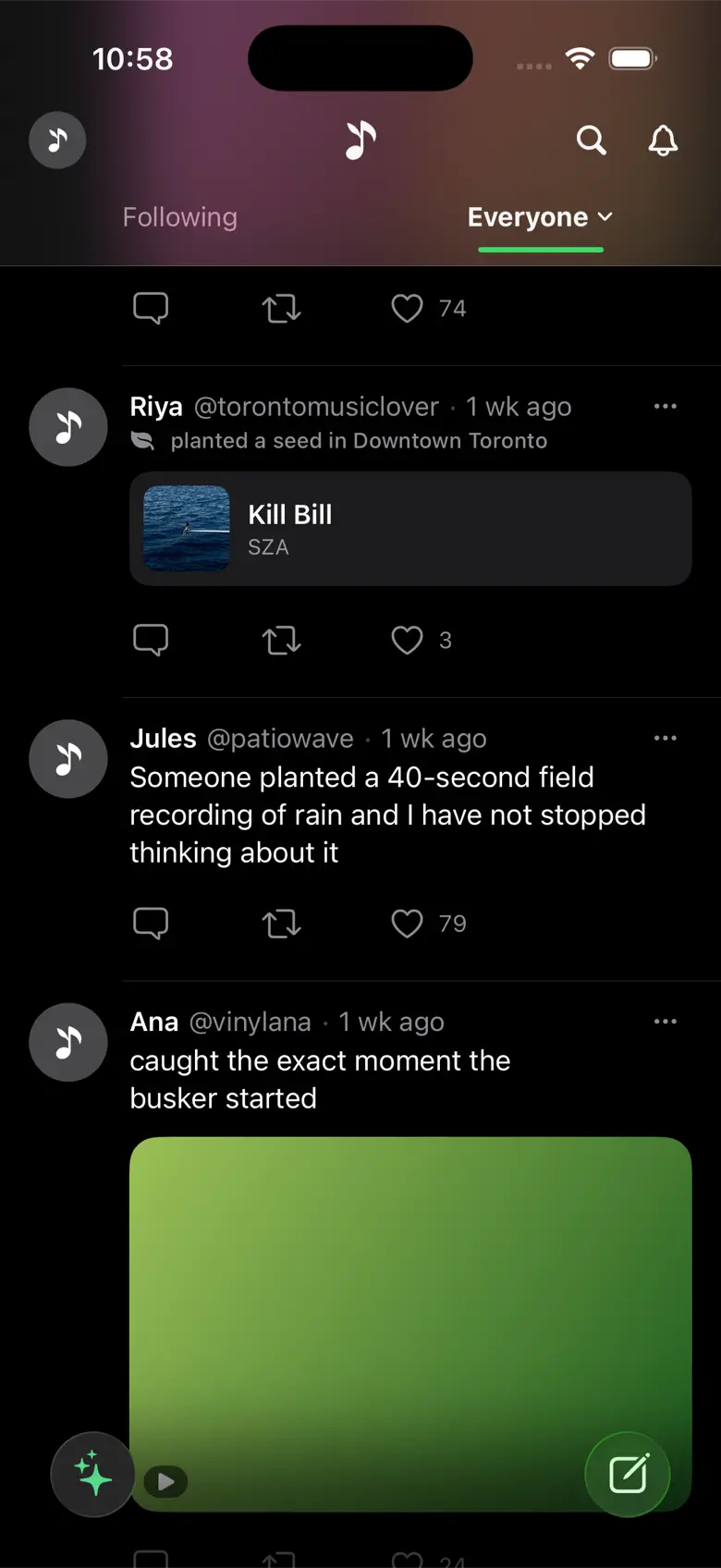
The feed names a neighbourhood, never a location. Finding the song is still on you.
This was tempting to get wrong. A feed with exact locations would be more immediately useful, and it would also be a better map than the map, which would quietly kill the walking.
So the feed is for atmosphere, not for navigation. You find out that something good is out there. You still have to go and find it.
What it actually plays
Meadow plays 30-second previews, the same ones you hear on a store page before buying.
It does not host music, sell it, or hand you a file, and it never will. That is not a gap I am planning to close. Music licensing being what it is, a small independent app does not get to serve full tracks, and pretending otherwise would be a good way to get removed from the App Store.
In practice the preview is the right length anyway. You are standing in a street, not settling in for an album.
What costs money
Finding is free. Leaving is what costs.
Collecting is unlimited and free forever. No daily cap, no garden limit, no paywall on the distances. Somebody could use the free version for a year without feeling like they were using a trial.
Meadow+ is $3.99 a month or $24.99 a year, with a first month at $0.99. It removes the weekly planting limit, extends how long your songs last from seven days to thirty, unlocks longer stats history and some different markers, and adds playlist export.
I picked that split because it matches what things actually cost me. Somebody collecting songs uses almost nothing. Somebody planting them is occupying a spot in a city for weeks at a time.
It also felt like the honest way round. The people getting the most out of Meadow for free are the ones walking, and they are the reason anybody plants anything.
How it is built, briefly
The app is native Swift, written with SwiftUI, with no third-party libraries in it at all.
The server runs on the Mac mini under my desk: a Postgres database with geographic support, so "which songs are within 200 metres of this person" is a question the database answers rather than something the phone works out.
Nothing on that machine is exposed directly to the internet. Traffic comes in through a tunnel, and the database enforces its own access rules, so a bug in the app cannot hand somebody data they should not see. Backups run nightly and encrypted.
That last part matters more than it sounds. If you are going to ask people to record where they have physically been, you owe them a serious answer about where that ends up.
Where it stands
Meadow works end to end today. Accounts, planting, collecting, the feed, moderation tools, subscriptions.
It is not on the App Store yet. There is a short list of things standing between here and submission, and I am working through it.
If you want to watch the last stretch happen, or argue with me about the seven-day expiry, join the Discord server. You can see more of the app at plantasong.com.
And if you take one idea from this, take the design constraint rather than the app. One rule I refused to break made every other decision easier, including the ones that cost me features I wanted.